The Head of Household standard deduction will be $18,350 for tax year 2019 compared to single taxpayers and married individuals filing separately, the standard deduction is $12,200. Married filing jointly is $24,400, but this is still a $12,200 deduction for each.
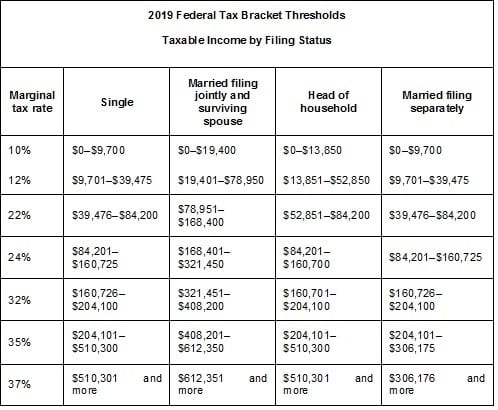
Filing as Head of Household widens the income brackets to which each tax rate applies, and this can be advantageous because you can earn more income before climbing into a higher tax bracket. For example, a Head of Household filer can earn up to $52,850 before they move into the 22% tax bracket as of 2019. The 22% threshold is only $39,475 for single filers in 2019.
Filing as Head of Household can also affect your eligibility for certain tax credits.
Spoiler Alert: It is not easy to qualify because the IRS has many rules and tests that must be met to qualify for filing as Head of Household:
2. You must have paid more than half the cost of maintaining your home for the year, and
3. You must have one or more qualifying dependents.
This table shows the tax rates that apply to Head of Household filers compared against the other filing statuses for the year 2019. Remember each segment of your income is taxed at the applicable bracket or percentage rate.
1. Are you unmarried?
A taxpayer must be unmarried on the last day of the year to file as Head of Household. This means that you are either single, divorced, or legally separated under a separate maintenance decree issued by a court. Even if your divorce isn’t final by December 31st, you might qualify as Head of Household if the IRS considers you “unmarried.” According to IRS rules, even if you’re still legally married but you lived in a separate residence from your spouse for at least the last six months of the year through the end of December, you are considered eligible to file as Head of Household. You must file a tax return separate from your spouse to claim Head of Household filing status, AND you must still meet the other two criteria for Head of Household status: the support test and the qualifying dependent test.
2. What support do you provide?
You must provide more than half the cost of keeping up your home for the year. Qualifying costs includes expenses like rent or mortgage interest payments, property taxes, property insurance, repairs, utilities, and groceries. The principal portion of your mortgage payment isn’t a qualifying cost. Things like clothing, education, medical care, life insurance, and transportation do not count either. If you have a roommate to help defray costs, you must personally pay at least 51% of the household expenses.
3. Do you have a qualifying dependent?
The dependent test is the most complicated rule of all. Your dependent would typically be your child, but other relatives can qualify, too. Your dependent must have lived with you for more than half the year, but some relatives, such as your parents, don’t have to live with you at all if you pay for more than half their living expenses (see below).
You must have the right to claim your dependent on your tax return even if you don’t actually do so. Perhaps you gave your spouse the right to claim a child as part of your divorce terms. A parent who is entitled to claim a child can transfer that right to the other parent by signing and submitting Form 8332 to the IRS. Only certain closely-related relatives can be qualifying persons for the Head of Household filing status, and they must live in your home for more than half the year. They include:
• Your mother or father who can be claimed as your dependent under the qualifying relative rules
• Your brother, sister, grandparent, niece, or nephew whom you can claim as a dependent under the qualifying relative rules.
4. Does your dependent meet the residency rule?
Your dependent must live with you for more than half the year, however there are two exceptions to the “more than 6 months rule:”
• A parent can be a qualifying person for a taxpayer who supports them even if they don’t reside in your home, as long as you can claim them as your dependent and you meet the support test. That means you pay more than half the cost of keeping up a home that was the main home for the entire year for your father or mother. In other words, if you pay more than half the cost of keeping your parents in a nursing home or home for the elderly, it counts!
CONTACT US: Marriage, separation and divorce can make filing your taxes a bit more complicated. See our prior article here: https://www.fuoco.com/resources/tax-alerts/483-a-dozen-ways-divorce-or-separation-impacts-your-2019-tax-return. So too can being a single parent, or individual caring for loved ones such as parents or dependent relatives. Head of Household is one of the most misunderstood tax filing statuses, but it comes with some great tax benefits for those who qualify. Let our tax experts help you explore your options. Filing as Head of Household can be very advantageous, we can assess if it will work for you and your unique situation. Call us toll free at 855-534-2727.